
California Dissolution of Marriage Records
Dissolution of marriage records in California are kept at two main places. The Superior Court in each of California's 58 counties holds complete case files. The California Department of Public Health maintains basic certificates for some years. You can search for these records online through court portals or request copies by mail. Most dissolution records in California are public documents that anyone can access.
California Dissolution Quick Facts
Superior Courts Keep Full Case Files
All 58 counties in California have a Superior Court. Each court keeps its own dissolution of marriage records. You file for dissolution in the county where you or your spouse lives. That same court stores the case file once the judge finalizes the dissolution. Files include the petition, response, settlement agreements, and the final judgment. The court clerk can make copies of any document in the file. Some courts let you search case information online for free.
Most California Superior Courts now use online portals for case searches. You can look up a case by party name or case number. The portal shows basic case details like the filing date and case status. Some courts also provide scanned copies of filed documents through their online systems. Each county runs its own portal, so the features vary from one court to the next.
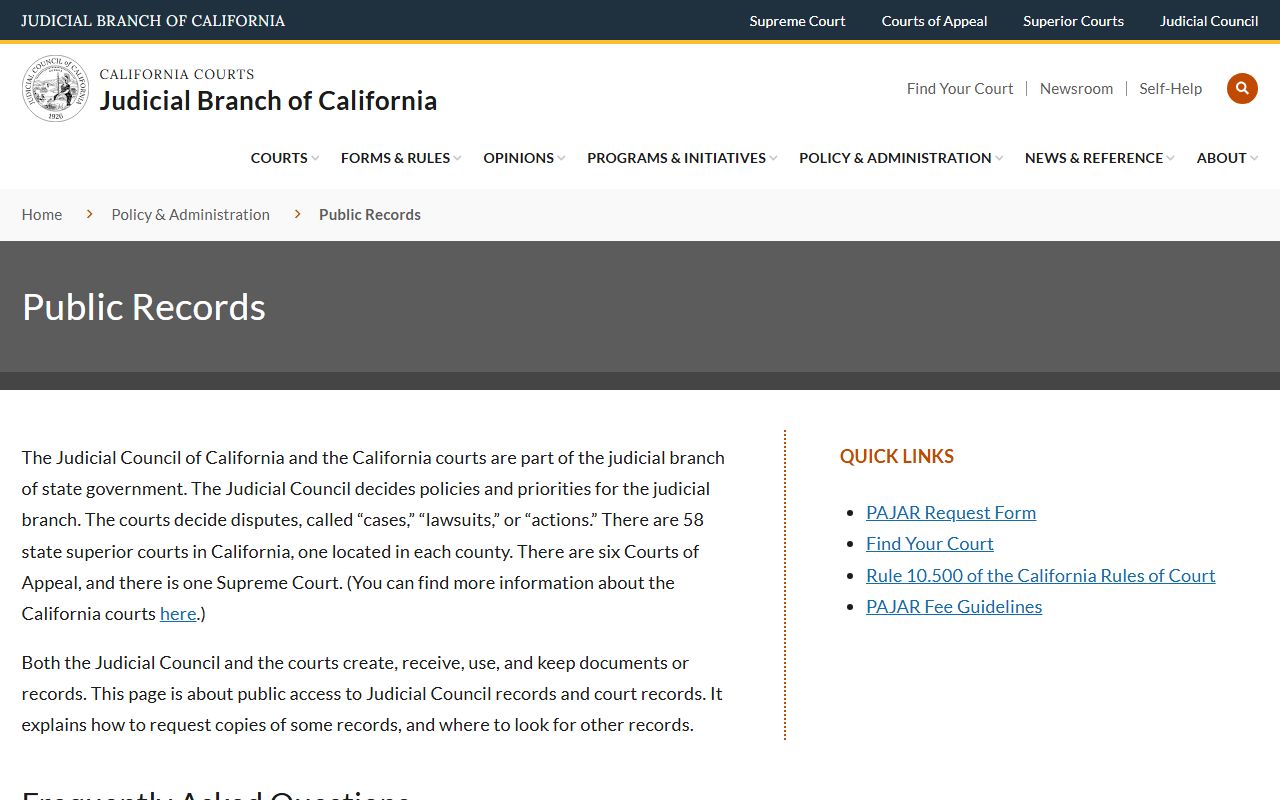
The California courts website at courts.ca.gov/policy-administration/public-records explains how court records work in the state. There are 58 state superior courts in California, one in each county. You must contact the individual superior court to ask for copies. Each court is in charge of keeping its own records.
Fees for certified copies vary but most counties charge $15 for a certified copy of a dissolution judgment. That fee includes the first few pages. Extra pages cost $0.50 each in most counties. Some courts charge a search fee if staff must spend more than 10 minutes looking for your record.
State Health Records from 1962 to 1984
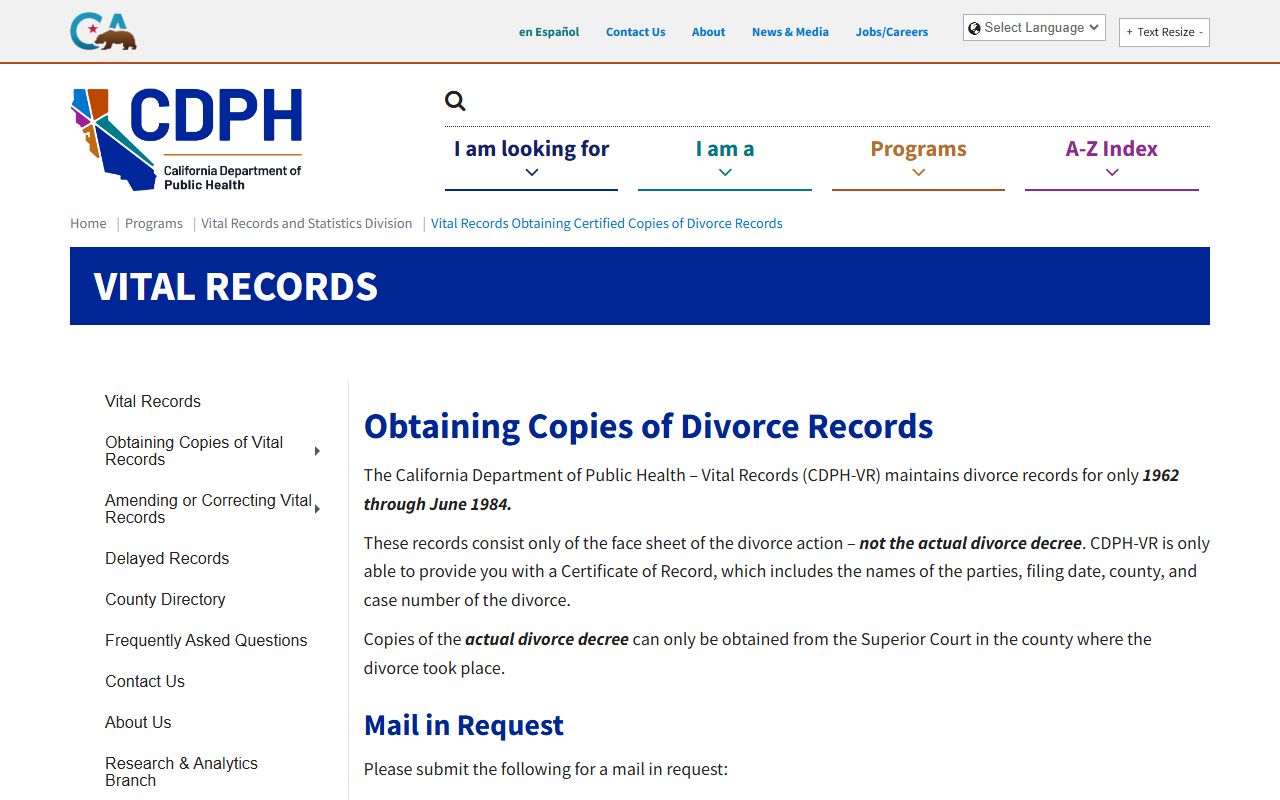
The California Department of Public Health used to maintain dissolution of marriage records. CDPH-VR now keeps records only for 1962 through June 1984. These records are not full decrees. They consist of the face sheet from the dissolution action. CDPH can give you a Certificate of Record that includes names of both parties, filing date, county, and case number. They cannot provide the actual decree or any settlement terms.
If you need a record from 1962 to June 1984, you can request it from CDPH-VR. The fee is $18 per copy. Send a check or money order payable to CDPH-VR. Mail your request to P.O. Box 997410, Sacramento, CA 95899-7410. Include the names of both spouses, the date of dissolution, and the county where it took place. Processing time for these records may exceed six months. For all other years, you must contact the Superior Court in the county where the dissolution occurred.
You can find more details about requesting these historical records on the CDPH divorce records page. CDPH only has basic information for dissolutions filed between 1962 and June 1984. Processing times may exceed six months.
Search Records Online
Many California counties offer free online case searches. These portals let you search by name or case number. You can view basic information like filing dates and case status. Some counties also let you view scanned documents from the case file. Access varies by county since each court runs its own system.
Large counties like Los Angeles, San Diego, and Sacramento have robust online portals with document images. Smaller counties may only show case summaries without full documents. You will need to visit the court or mail a request to get certified copies. Online searches give you a quick way to confirm that a case exists and check its current status before you request official copies.
Note: Online portals are for research only and do not provide certified copies in most cases.
California Dissolution Laws
California law governs how dissolution of marriage cases work in the state. Residency rules require that you or your spouse lived in California for at least six months before filing. You must also have lived in the county where you file for at least three months. These requirements appear in California Family Code Section 2320.
California is a no-fault state. That means you do not need to prove wrongdoing to get a dissolution. The only grounds are irreconcilable differences or permanent legal incapacity to make decisions. Most people file based on irreconcilable differences. This ground appears in California Family Code Section 2310. Fault does not matter when dividing property or deciding support in California.
The state has a six-month waiting period from the date of service before a dissolution can become final. The court cannot enter a final judgment until this time passes. During the wait, temporary orders can address custody, support, and use of property. Once the six months are over and all issues are resolved, the judge signs the final judgment of dissolution. The judgment ends the marriage and becomes part of the court record in California.
California divides property using community property rules. Property acquired during the marriage is split equally between both spouses in most cases. Separate property that one spouse owned before the marriage or received by gift or inheritance stays with that spouse. This rule is set out in California law and affects how assets get divided in dissolution cases across the state.
Filing for Dissolution in California
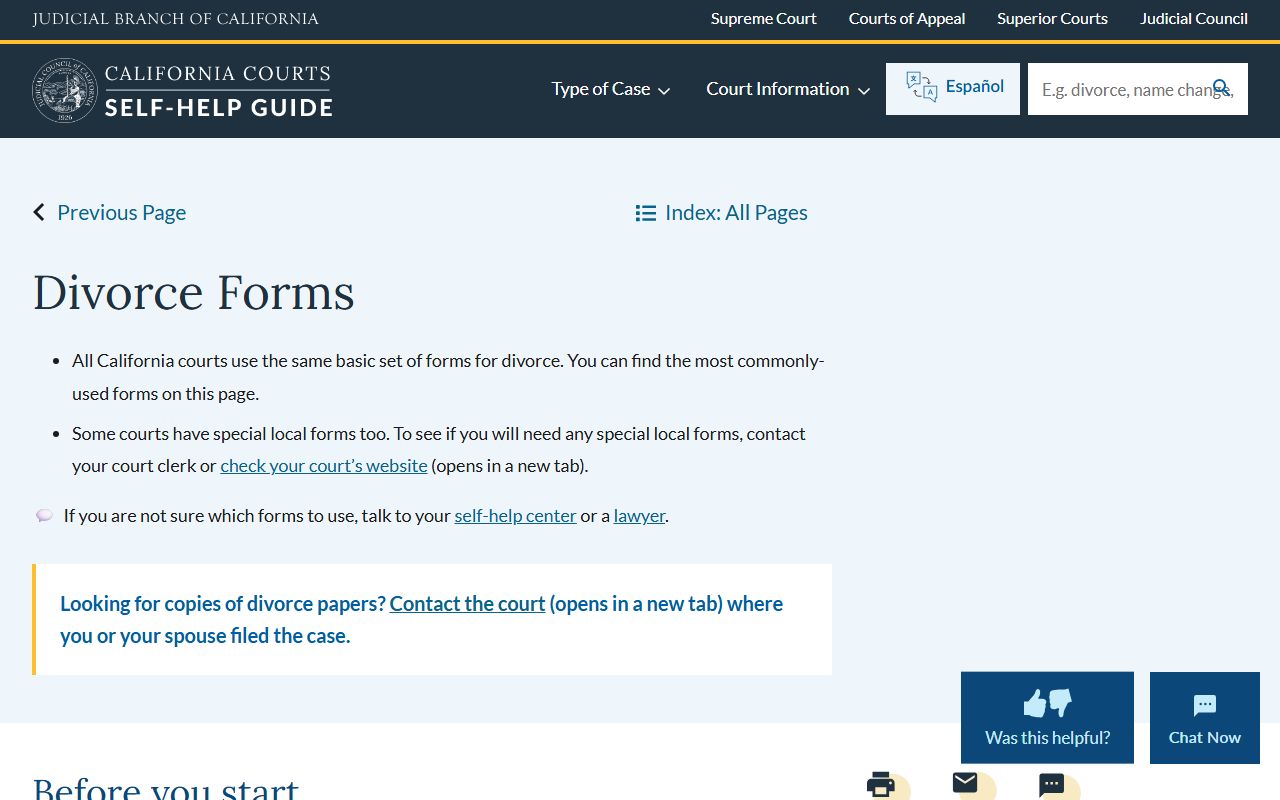
All California courts use the same basic set of forms for dissolution cases. You can find these forms on the California Courts self-help divorce forms page. The main forms include the Petition (FL-100), Summons (FL-110), and Response (FL-120). Other forms handle issues like child custody, support, and property division.
The filing fee to start a dissolution case ranges from $435 to $450 in most California counties. You pay this fee when you file the petition. If you cannot afford the fee, you can ask the court to waive it by filing a fee waiver request. The court will decide if you qualify based on your income and assets. Each county sets its own fees for copies and other services, but the filing fee is set at the state level.
After you file the petition, you must serve it on your spouse. Service means giving official notice of the case to the other party. California law requires that someone other than you deliver the papers to your spouse. You can use a process server, sheriff, or any adult who is not part of the case. The server fills out a Proof of Service form that you file with the court. This step is required before the case can move forward in any California county.
What These Records Contain
Dissolution of marriage records in California vary based on where you get them. Court records from the Superior Court include all documents filed in the case. That means the petition, any responses, financial disclosures, settlement agreements, and the final judgment. You can also find motions, orders, and transcripts if hearings took place. These files give a complete picture of how the case was handled.
A Certificate of Record from CDPH for the years 1962 to June 1984 shows less detail. The certificate lists names of both parties, the filing date, the county where the case was filed, and the case number. It does not include any terms of the settlement or reasons for the dissolution. Many people use this certificate to prove that a dissolution took place when they need to update legal documents or remarry.
Typical information found in California dissolution records includes:
- Full names of both spouses
- Date and location where the marriage took place
- Date when the petition was filed
- County and court handling the case
- Final judgment date
- Terms related to custody, support, and property
Court files may also hold financial records like income and expense declarations. These forms show each party's financial situation at the time of the dissolution. Such documents are part of the public record unless a judge orders them sealed. Sealed records are rare and require a court order based on privacy concerns or safety risks.
Public Access to Records
Dissolution of marriage records are public in California. Court case files are subject to public inspection under state law. Anyone can ask to see these records. You do not need to be part of the case. You do not need to explain why you want the records. The court must allow access unless a judge has sealed the file.
Some information may be redacted from public copies. Financial account numbers and details about minor children often get removed to protect privacy. Social Security numbers are also blacked out in most cases. A party can ask the court to seal the entire case file if they have a strong reason. The judge will hold a hearing and decide if sealing is justified. Most dissolution cases remain open to the public throughout California.
The California Public Records Act in Government Code Section 7920.000 gives the public the right to inspect records. This law applies to court records as well as other government documents. It ensures that dissolution records stay accessible unless specific privacy protections apply.
Getting Certified Copies
A certified copy has an official stamp or seal from the court clerk. This type of copy is accepted as proof in legal matters. You need a certified copy when you update your name with Social Security or get a new driver's license. You may also need one to remarry or to prove the dissolution in another legal case.
To get a certified copy, contact the Superior Court clerk in the county where the dissolution was filed. You can visit in person, call, or mail a request. Include the case number or the names of both spouses. Include the date of the dissolution if you know it. Pay the fee, which is usually $15 for the first few pages plus $0.50 for each extra page. The clerk will make the copy and apply the official seal.
Wait times vary by county. In-person requests are often processed the same day or within a few days. Mail requests can take two to four weeks. Some counties have online request forms that speed up the process. Check the court's website for specific instructions and current fees before you submit your request in California.
Locate Your Local Court
Each California county has one Superior Court. Some counties have multiple courthouses in different cities, but all locations are part of the same court system. To find the right court for your dissolution records, you need to know the county where the case was filed. If you are not sure which county, think about where you or your spouse lived when the case started.
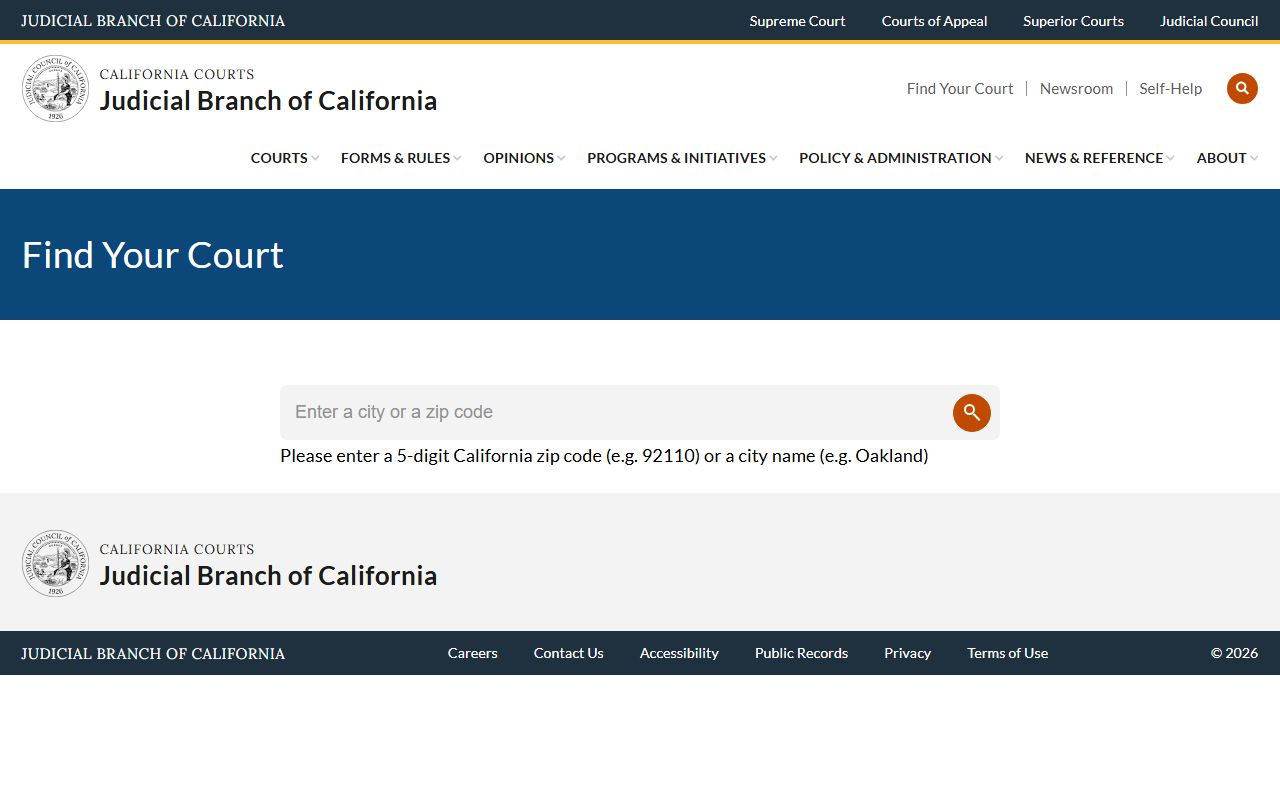
The California courts website offers a tool to help you find your local court. Visit courts.ca.gov/find-my-court and enter your county name. The tool shows contact details, hours, and links to that court's website. You can also find information about online case searches and forms specific to that county.
Once you identify the correct court, check if they have an online portal for case searches. Many counties let you search for free by name or case number. This step can save you time before you visit in person or mail a request for certified copies.
Fees Across California
Costs for dissolution records vary based on what you need and where you get it. Most counties charge $15 for a certified copy of a dissolution judgment. This fee usually includes the first few pages. Each extra page costs $0.50 in most places. If you need copies of other documents from the case file, the same per-page rate applies.
Some counties charge a search fee if the clerk must spend time looking for old records. This fee is often $15 for searches that take more than 10 minutes. Not all counties have this fee, so check with your local court. Online searches through county portals are free in most cases, but you still pay for certified copies if you need them.
CDPH charges $18 for a Certificate of Record from the years 1962 through June 1984. This fee covers one certified copy. If you need more than one copy, the cost increases. Keep in mind that processing at CDPH can take six months or longer, so plan ahead if you choose this route for historical records in California.
Browse by County
Each California county maintains dissolution records at its Superior Court. Pick a county below to find local contact details and online resources.
Major California Cities
Residents of California cities file dissolution cases at their county Superior Court. Select a city below to learn about records in that area.